
If you’re building heavy equipment, you already know the weld is not the problem.
The challenge is everything around it.
Large parts. Variable fit-up. Thick materials. Long cycle times. And a constant push to keep production moving without sacrificing quality.
That’s where the right robotic welding system makes a difference.
Not just the robot, but how the system handles sensing, control, and real-world variation on the floor. And just as important, who is standing behind it when production is on the line.
This is a look at the types of robotic welding systems that actually hold up in heavy machinery manufacturing, construction machinery plants, and agricultural equipment manufacturing. Not based on specs alone, but on how they perform when things are not perfect.
If you’re evaluating robotic welding systems for heavy equipment, send us your part or walk us through your process.
Or start with our automation readiness checklist to get a clearer picture of what type of system fits your operation.
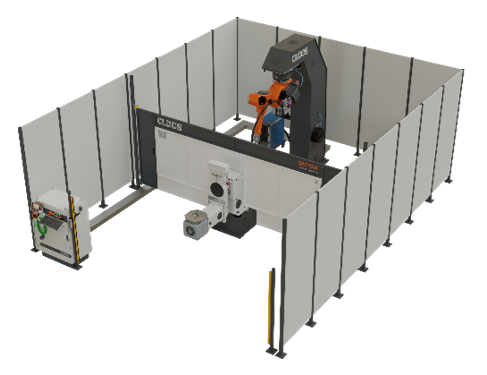
1. Pre-Engineered Robotic Welding Cells
Best fit: Shops getting started with automation or running consistent, repeatable parts
Pre-engineered systems are designed to get up and running quickly. They are often compact, standardized, and easier to deploy.
Where they work well:
- Smaller components with consistent geometry
- Shops new to industrial welding automation
- Projects with limited floor space
Where they fall short:
- Limited flexibility for large or complex parts
- Sensor integration is often basic or optional
- Harder to scale as production grows
What to look for:
- Basic seam tracking capability
- Simple controller interface for operators
- Clear upgrade path if production expands
These systems can be a good starting point. Just make sure you are not outgrowing it before it is paid off.
If you’re early in the process, a readiness checklist can help you understand whether a pre-engineered system makes sense or if you need something more flexible.
2. Modular Robotic Welding Systems
Best fit: Manufacturers planning to grow or expand automation over time
Modular systems are built with expansion in mind. Additional stations, positioners, or robots can be added without starting over.
Where they work well:
- Medium to large fabrications
- Mixed part production
- Facilities planning phased automation
What sets them apart:
- Flexible layout design
- Easier integration of advanced sensors
- Scalable controller architecture
Sensor and controller integration:
- Seam tracking systems that adjust in real time
- Touch sensing for part location
- Controllers that manage multiple stations or robots
This is where many heavy equipment manufacturers land once they move past entry-level automation.
It is also where support starts to matter more. As systems expand, you are no longer just maintaining equipment. You are managing a production asset that needs to adapt over time.
3. Gantry and Large-Scale Robotic Welding Systems
Best fit: Large structural components and high-volume heavy fabrication
When parts get bigger, traditional robot reach becomes a limitation. Gantry or track-mounted systems extend that reach across large weldments.
Where they work well:
- Construction machinery frames
- Agricultural equipment structures
- Long or oversized weldments
What matters most here:
- Stability and repeatability over long distances
- Coordinated motion between robot and track
- Advanced sensing to handle distortion and variation
Sensor and controller integration:
- Multi-axis coordination between robot and gantry
- Real-time seam tracking across long weld paths
- Centralized control systems managing large work envelopes
These systems are not about speed alone. They are about maintaining consistency across large, complex parts.
And when something goes down, the impact is immediate. That is where responsive support and access to expertise become just as important as the system itself.
4. Multi-Robot Welding Systems
Best fit: High-volume production environments with complex weld sequences
When cycle time becomes the bottleneck, adding more robots can be more effective than pushing one robot harder.
Where they work well:
- Repetitive, high-volume production
- Complex assemblies requiring multiple weld passes
- Operations where throughput is critical
What to consider:
- Robot coordination and collision avoidance
- Load balancing between stations
- Controller capability to manage multiple robots
Sensor and controller integration:
- Shared sensing systems across robots
- Central controller managing synchronized operations
- Data feedback for production monitoring
These systems require more planning upfront, but they deliver when production demands are high.
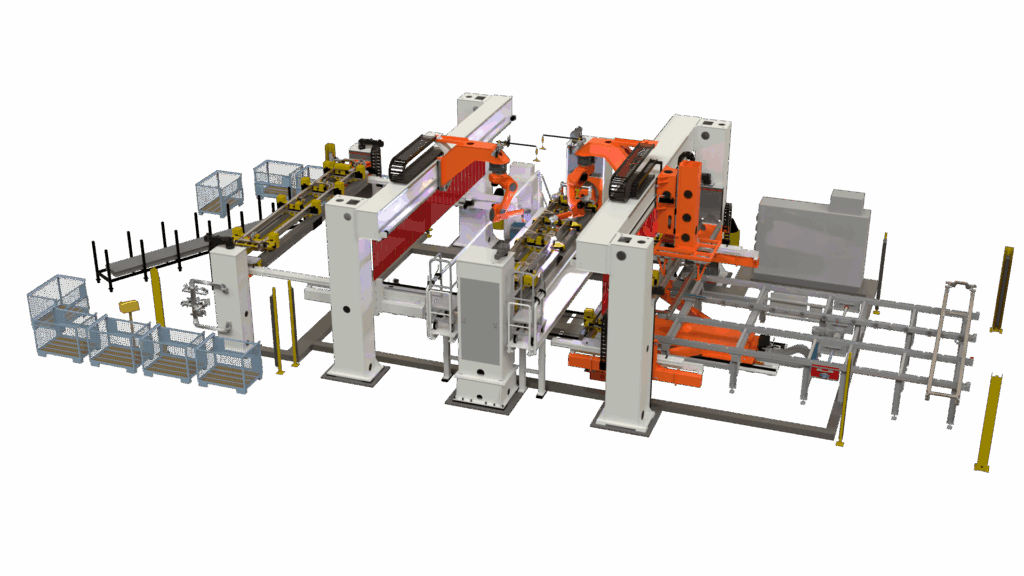
5. Custom Engineered Robotic Welding Systems
Best fit: Manufacturers with complex parts, high variability, or unique process requirements
This is where automation shifts from a product to a solution.
Custom systems are designed around the part, the process, and the production goals. Not the other way around.
Where they work well:
- High-mix, low-volume environments
- Complex weld geometries
- Operations with tight quality requirements
What sets them apart:
- Tailored fixturing and part handling
- Advanced sensing strategies
- Full integration of upstream and downstream processes
Sensor and controller integration:
- Vision systems for part detection and alignment
- Adaptive welding parameters based on real-time feedback
- Integrated control of welding process, motion, and material flow
This is typically where manufacturers end up after working through the limitations of more standardized systems.
At this level, the system is only as strong as the team behind it. Ongoing support, process knowledge, and the ability to make adjustments over time are what keep the system delivering value.
What This Really Comes Down To
There is no single “best” robotic welding system.
There is only the system that fits your parts, your process, and your production goals.
But the system is only part of the decision.
The manufacturers who get the most from automation are not just choosing equipment. They are choosing a partner who can support the system, adapt it, and keep it running when it matters most.
Because even the best-designed system will need adjustments. New parts will be introduced. Production demands will change. And when something stops, the response matters.
If you are evaluating robotic welding systems for heavy equipment, look beyond the layout and the specs. Pay attention to how the system is supported and who is responsible for keeping it running.
If you are going to invest in automation, it is worth doing right.
And that includes choosing the right partner, not just the right system.
FREQUENTLY ASKED QUESTIONS
What type of robotic welding system is best for heavy equipment manufacturing?
It depends on part size, volume, and variability. Larger and more complex parts often require modular or custom-engineered systems with advanced sensing and control.
Why is sensor and controller integration important in robotic welding?
Because real-world parts are not perfect. Sensors and integrated controls allow the system to adjust for variation, improving weld quality and reducing rework.
Can robotic welding systems handle large structural components?
Yes, but they often require gantry systems or track-mounted robots to provide the necessary reach and stability.
How important is support when choosing a robotic welding system?
It is critical. Most issues in automation are not caused by the equipment itself, but by how it is maintained, adjusted, and supported over time. Strong support reduces downtime and helps the system continue to perform as production needs change.